Essays
A Consensus on Precision Therapy
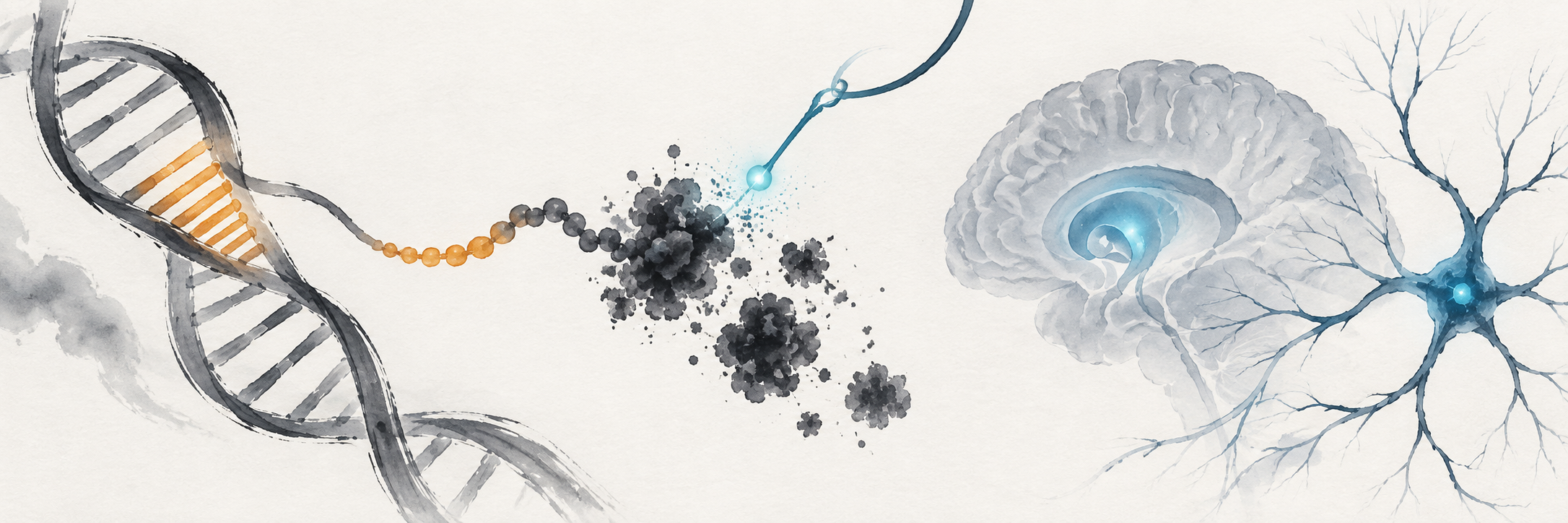
Huntington's disease begins with a change in huntingtin, a protein that healthy people also make and which helps cells perform ordinary work, including transporting materials within neurons. In people with Huntington's, a repeated stretch of its genetic instructions becomes too long, setting off a process that eventually damages movement, thinking and psychiatric health. Understanding how that change produces disease has taken decades, and it has gradually changed what clinicians are trying to target in therapeutics. [1] [2] [3]
Researchers mapped the disease to chromosome 4 in 1983 and identified the gene, HTT, ten years later, discovering the stretch where the DNA letters CAG repeat over and over. When the cell copies the gene into RNA and uses that RNA to make huntingtin, each CAG repeat produces another glutamine molecule, one of the building blocks of protein. We all have this stretch, but with 40 or more repeats, the mutation is expected to cause disease within a normal lifespan, while 36 to 39 leads to a variable risk. Longer inherited repeats generally brings disease earlier, although people with the same count can develop symptoms decades apart. [1]
In her 2025 Royal Society lecture, Gillian Bates, a neuroscientist at University College London, chronicles the experiments that expanded our knowledge into the current era. She starts with researchers finding abnormal huntingtin clumps inside neurons. They tested these clumps with antibodies, which bind to particular regions of a protein. They saw that an antibody recognizing the beginning of huntingtin, its N-terminus, labelled the clumps, while another recognizing a region farther along failed to label them. So the clumps appeared to contain shortened protein pieces from the beginning of the full-length huntingtin, directing attention to the region where the mutation sits. [1]
Further experiments showed that short huntingtin proteins containing the expanded glutamine stretch could assemble into amyloid, which are tightly organized protein fibers. So the question became how the cell was producing these small, troublesome pieces, and researchers initially investigated whether enzymes were cutting them from full-length huntingtin. [1]
But one fragment matched the protein segment encoded by the gene's first exon, which suggested another route. Exons are the sections retained when the cell processes its RNA copy of a gene, while the intervening sections, called introns, are normally removed. In HTT, the first exon supplies the instructions for the beginning of huntingtin, including its glutamine stretch, so researchers wondered if the cell was making a short RNA that supplied only those instructions. [1]
Bates's group reported their findings on this process in 2013, showing that with expanded repeats, RNA processing can end prematurely within the first intron, producing a short RNA called HTT1a. It retains exon 1 and some intronic sequence, and makes the small exon-1 huntingtin protein, with subsequent work detecting this RNA in human Huntington's brain tissue. If we imagine full-length mutant huntingtin as a long rope with a sticky patch near one end, HTT1a supplies the instructions for making just that sticky end on its own. This plausibly gives the cell a way to produce the material that was known to clump most readily. [1]
Meanwhile, other researchers were finding that the repeat count a person inherits can increase within their cells over a lifetime, a process called somatic expansion. So a blood test gives us an incomplete picture of the mutation in the brain. People who inherit something like 42 repeats can have individual neurons containing hundreds. These extreme expansions concentrate in the medium spiny neurons of the striatum, the population that dies most heavily in Huntington's, and it can be demonstrated that longest expansions correspond with pronounced disruption of normal gene activity as well. [1]
But why would a repeated sequence continue growing inside an adult cell? The answer appears to involve the machinery meant to protect DNA. Repeated CAG sequences can misalign when DNA is copied or handled, creating small loops which look like errors. The mismatch-repair system recognizes these abnormal structures and attempts to correct them. With an unstable repeat, however, that repair can add CAGs to the sequence, leaving the next repair attempt with a still longer and less stable stretch. The cell's editor can therefore become part of the copying error. [1]
Supporting evidence arrived from two directions. Beginning in 2015, large human genetic studies found that many of the strongest modifiers of disease onset belonged to the DNA mismatch-repair system. In other words, inherited differences in repair genes helped explain why two people with similar CAG counts could develop disease at different ages. And this matched an older result from mice, where knocking out the mismatch-repair gene MSH2 prevented much of the expansion in the striatum. Experiments with other mismatch-repair genes produced similar results. Removing a repair gene and watching the expansion largely stop is good evidence that the repair process helps drive it. [1]
This does not completely answer why medium spiny neurons are especially affected. But we can state with reasonable confidence that the largest expansions occur in certain vulnerable cells, and the activity or balance of repair proteins may contribute to that pattern. This hypothesis does provide an upstream therapeutic target. If researchers can restrain the particular repair activity that lengthens CAG repeats, they may be able to hold the mutation closer to the length a person inherited. And because somatic expansion occurs across other repeat disorders, the same strategy could potentially apply beyond Huntington's. [1]
Bates's experiments then connect expansion back to HTT1a, whose production rises as the repeat grows longer. Together, these findings suggest how an inherited mutation could change within particular neurons for decades before generating much larger amounts of a harmful protein. The emerging sequence is somatic expansion, increasing HTT1a, greater aggregation pressure and finally cellular dysfunction. The extent to which HTT1a explains human disease remains a question for experiments. [1]
One such experiment substantially reduced production of the exon-1 protein in mutant mice. Clumps appeared months later, and some abnormalities in the activity of other genes improved. These abnormalities are called transcriptional dysregulation, meaning that the cell is producing the wrong amounts of RNA from its genes. Markers of neuronal injury and inflammation also remained at normal levels in the mice from this experiment. Although this was only a partial rescue, it supplied evidence that changing HTT1a production could change the course of cellular damage. [1]
Now given that mutant huntingtin causes disease, reducing its production thus seemed a reasonable way to help patients. Tominersen, developed by Ionis and Roche, uses an antisense oligonucleotide, a short synthetic molecule that binds a matching RNA and directs its destruction. An early trial showed that the drug lowered huntingtin measured in the fluid surrounding the brain and spinal cord. [1]
But during the larger Phase III trial, involving more than 800 participants, a different result was established. After 69 weeks, the independent monitoring committee stopped dosing partly because of safety concerns and partly because treated patients appeared to be doing worse than those receiving placebo. The failed trial established a problem with the treatment tested, while leaving its cause unresolved. [1]
I believe the position of tominersen's target is the complication, because it binds farther along the RNA than HTT1a extends. This reduces full-length huntingtin from both the normal and mutant gene copies while leaving the short RNA unaddressed. Regardless of my speculation, it is undeniable that the result mixes possible effects of losing normal huntingtin, lowering mutant huntingtin, leaving HTT1a behind, and the drug's own toxicity all in question. We cannot assign the clinical worsening to any one of these from that trial. Bate's referenced later mouse experiments that compared lowering full-length huntingtin with lowering HTT1a. The treatment aimed only at full-length huntingtin achieved roughly 80% reduction and had little effect on huntingtin clumping or abnormal gene activity. The HTT1a-directed treatment achieved only about 50% reduction and produced a much larger effect. So a larger fall in total huntingtin demonstrated a smaller effect on the process we hoped to change. Bates speculated that the form of protein a treatment lowers may matter more than how much huntingtin it removes in total. [1]
The approaches covered in Bates's lecture outline the current map of the choices clinicians have made. Tominersen and the other small molecules discussed from PTC and Novartis target full-length huntingtin. Wave's approach seeks to distinguish the mutant gene copy from the normal one, although its target leaves HTT1a outside its reach (the trial ultimately failed due to a inability to make the distinction in any case). By contrast, uniQure's AMT-130 and Alnylam's RNA treatment target exon 1, a region shared by the full-length and short RNAs. They can address HTT1a, but that coverage alone gives them no ability to preserve normal huntingtin. AMT-130 also requires AAV delivery into the brain through a long surgical procedure going through the skull. [1]
There are experiments that target the intronic sequence retained in HTT1a, potentially offering a cleaner distinction from mature full-length RNA. Other approaches could go more upstream, seeking to restrain somatic CAG expansion through mismatch repair or to directly edit the repeat itself. In principle, editing could shorten the repeat, interrupt the long run of CAGs or disable the mutant gene copy while preserving the normal one. But permanently editing enough neurons creates a much higher delivery and safety hurdle than trialing a reversible RNA drug. These methods are also much earlier in development and remain mostly theoretical.
What precision should mean
Normal huntingtin's value has experimental support. Frédéric Saudou describes huntingtin as part of a protein complex that transports vesicles along microtubules, the cell's internal tracks. When mutant huntingtin joins that complex, vesicles detach more often and transport becomes less efficient, reducing the neuron's capacity to release the trophic factors and neurotransmitters it needs. [3]
Michael Hayden makes the related argument more directly. Increasing ordinary huntingtin can protect neurons, while knocking it down in a healthy adult animal can produce neurodegeneration on its own. Yet he also allows that modest lowering of both normal and mutant huntingtin may prove feasible. Treatment could continue for twenty or thirty years, making the amount of normal protein retained a question of long-term safety whose answer is unknown and would be difficult to validate in more reasonable timeframes. [2]
So onto the language of precision medicine. The phrase seems to be commonly used in almost the same sense as personalized medicine, meaning that treatment is chosen using the characteristics of an individual patient, their genes, biomarkers, environment or disease subtype. Personalized medicine already describes that idea clearly. Calling it precision medicine adds a suggestion of accuracy without being explicit about what has become more accurate.
Still, precision may merit its own usage if we use it to set a higher bar for the intervention itself. In the described clinical therapies, culling normal huntingtin can be an intended molecular effect, so describing it as off-target is not objectively correct, though that it is collateral damage that should be self-evident. For me, precision should therefore require pathological selectivity, preserving normal function wherever the disease provides a practical way to distinguish it from the pathogenic process.
Even if trials still fail with this definition of precision, it would increase what we can learn. A selective intervention makes its result easier to interpret, provided we establish that it reached the relevant cells and reduced its target sufficiently. Continued disease could still reflect late treatment or irreversible damage, and partial improvement would leave further mechanisms to investigate. Admittedly, science is a moving target, and practitioners have to try treatments while gross uncertainties remain. But if the term precision is to help move the field forward, I believe preserving normal biology should be an explicit usage requirement, with departures justified only by the limits of what is knowable to us at the time.