Essays
Semantics of Aging
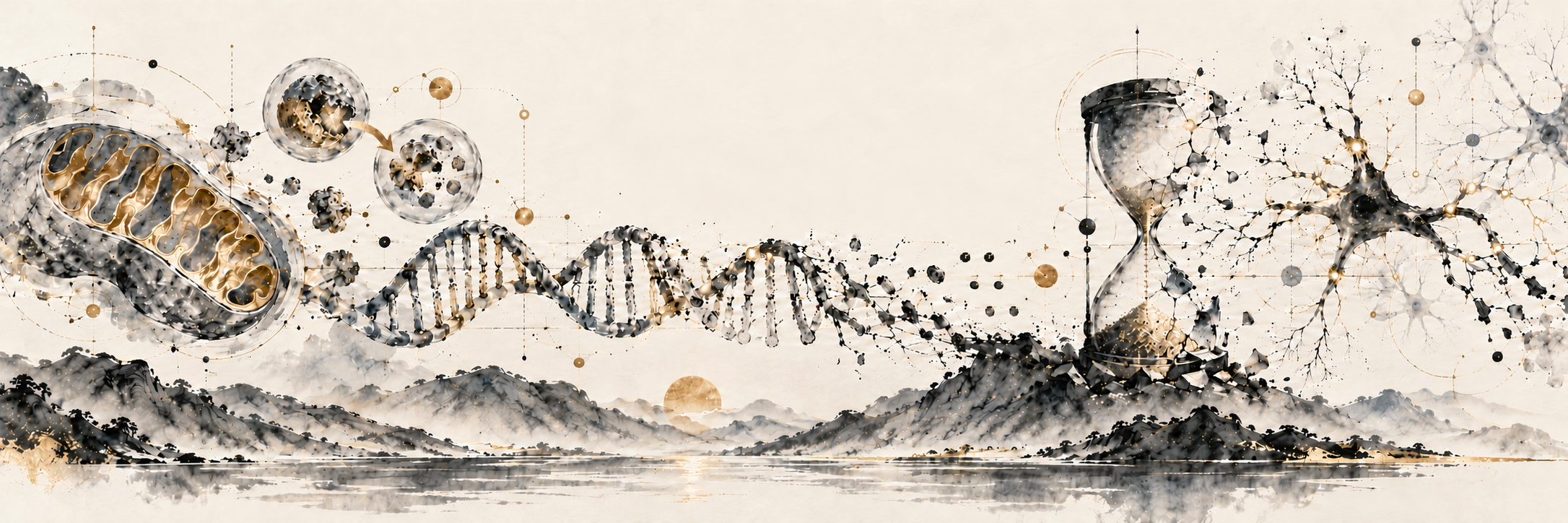
As our collective knowledge and ability to study the micro has improved, new theories on the biological process of aging have formed. Descriptions of aging have gone from a rather abstract concept of vague but inevitable time-bound entropic system collapse to one of nuanced, gradual, accumulating but mechanistic biological component failure, involving a broad set of genetic and cellular metabolic breakdowns which en masse lead to the outcome of “aging.” And moreover, while damage accumulates, we now suspect that the rate at which it accumulates depends partly on how cells regulate their own maintenance, as changing that regulation has been shown to change lifespans of experimental organisms. [1]
While there is, in hindsight, a natural intuition to this, it does force us to confront semantic complexity. For instance, a car can fail catastrophically from transmission failure, or in a correctable way, such as from a lack of motor oil. But at what point does the car become too old to fix? When the miles are too high, simply a function of use? Or is it when the amalgamation of individual component failures becomes too great to make it economical to fix, to the point where you need to replace all the components because of rust, sagging frames, leaky parts, faulty wires and so on? Yet, if mechanics did replace all those parts, continuously, in a world where a car had infinite value worth preserving, it seems likely that mileage would become just a number and not an “age” with an implication of finiteness.
In a lecture, Matt Kaeberlein illustrates the implications of this, estimating that while even curing all cancers would increase life expectancy for an average 50-year-old American woman only by about three years, slowing biological aging could potentially produce substantially greater gains in healthy lifespan, which is a very interesting reframe, even if somewhat speculative. [2]
Neurodegenerative diseases like Alzheimer's further highlight the semantic shift that is likely occurring, as scientists are forced to confront what it is that might separate a neurodegenerative disease from “typical” aging. There are clear hallmarks of differentiation. Ordinary cognitive aging can involve slower processing and more difficulty learning or retrieving information, while vocabulary and long-established knowledge can remain relatively well preserved. Alzheimer's disease can produce progressive failures of memory, orientation, language and other abilities that eventually interfere with independent life. Its characteristic pathology includes deposits of amyloid-beta between cells and tangles of the protein tau within neurons, accompanied by damage to synapses, the connections through which neurons communicate, and loss of neurons in affected regions. Some of these protein deposits also occur in cognitively intact older people. Their distribution, extent and relationship to functional damage matter more than their mere presence. [3,4]
There are open questions, however, including the hypothesis discussed by Anderton that on a prolonged timeframe, perhaps at around 130 years, all individuals might develop dementia-like impairment through accumulated synaptic loss, even without Alzheimer's disease. This remains speculative, but challenges clean distinctions of what pathology is, i.e. disease versus “natural aging.” [3]
What is the purpose of the semantic shift ongoing? The primary consequence is to alter the discussion around biological health. It may be that aging is not a single phenomenon in itself, with a separate time-dependent inevitability, but a collection of type-dependent component failures. Time would still matter because damage, exposures and imperfect repair accumulate through it. The question is whether elapsed time explains the failure, or whether it is standing in for biological events that we might eventually distinguish and alter. The ability to change lifespan by changing particular genes supports the latter possibility. [1,2]
And this shifts how we could frame disease. A disease with increasingly complex and myriad genetic and non-genetic factors may not be one “Parkinson's,” but a potentially vast, mechanically pathway-bound set of disturbances which over time lead to catastrophic systems failure and express in macro-level, historically “Parkinson's-like” presentations. This is similar to the possibility I considered in ALS and ASOs, where many initiating disturbances might converge on a smaller set of cellular failures. The similarity of the final symptoms could identify the machinery that has failed without uniquely identifying what started its failure.
Disease will probably need to become more fine-grained, moving from broad terms where we try to cluster multitudes of root causes toward individually derived pathway failures, which we then aggregate upwards toward the macro. Alzheimer's provides a useful example of what such a description would have to distinguish. Amyloid-beta is produced when enzymes cut a larger protein called amyloid precursor protein, or APP. Certain inherited changes in APP or in the machinery that cuts it can alter the amount or forms of amyloid-beta produced. APOE, by contrast, encodes a different protein, apolipoprotein E, whose variants can influence how amyloid-beta accumulates. These are different points in the process, even when both contribute to pathology that receives the same disease name. [4]
An experiment by Joseph Castellano and colleagues can help exemplify this. In mice carrying different human forms of apolipoprotein E, the researchers found differences in the clearance of soluble amyloid-beta from fluid between brain cells, without corresponding differences in its production in the young mice studied. It showed how levels of protein accumulation can differ because removal rates differ, rather than because production has increased. [5] A future description of Alzheimer's-like disease might therefore specify an APOE-associated clearance failure without increased APP expression, leading to the historical macro-level Alzheimer's symptomatic expression.
Over time, perhaps the legacy names would get dropped in favor of these more specific expressions. While there is a struggle with this, such as amassing funding for a framework of medicine that may divide familiar diseases into many smaller groups, it is perhaps necessary to rapidly increase progression against human biological failure. And from this then, aging could become a legacy term as well, moving from a vague catch-all bucket to fine-grained component failures which may form from unique combinations but eventually converge into similar mechanical pathways.
As it stands, there seem to be a few prominent clusters of frequently occurring pathway failures, arising from various genetic combinations and acting through countless cellular processes which we are likely only scratching the surface of. We could categorize influences on these processes into accelerants and decelerants, factors which increase combinatorial degradation rates and factors which reduce them. [1,2]
Genetic studies have identified many genes which influence these processes. One of the clearest examples comes from Cynthia Kenyon's work in the worm Caenorhabditis elegans. Certain mutations that reduce the activity of daf-2 can approximately double the worm's lifespan. The gene encodes DAF-2, a receptor related to the human receptors for insulin and insulin-like growth factor 1, or IGF-1. These hormones help coordinate nutrient use and growth. When the worm's DAF-2 receptor is active, it triggers enzymes to attach phosphate groups to another protein, DAF-16, limiting its accumulation in the nucleus. DAF-16 is a transcription factor, meaning that it binds DNA and regulates the expression of other genes. [6]
Reducing DAF-2 signaling allows more DAF-16 to act in the nucleus, changing the expression of genes involved in stress resistance, metabolism and cellular maintenance. Removing daf-16 from the long-lived daf-2 mutants removes the lifespan extension. Researchers also reduced the activity of individual downstream genes to test whether the changes in their expression actually contributed to longevity, which many did. [6]
Kenyon's group also asked when DAF-2 activity needed to change. They used RNA interference, a method that reduces a gene's activity by directing the destruction of its messenger RNA, to turn down daf-2 at different stages of the worms' lives. Worms treated only from adulthood lived as long as those treated from hatching. Their development had already taken place under ordinary DAF-2 signaling, and changing the pathway could still extend the life of the adult animal. [6]
The cellular response is broad because a regulatory protein can alter many maintenance processes together. Among the downstream changes are increased production of proteins that help other proteins fold correctly and enzymes that limit damage from reactive oxygen molecules. Other regulators feed into overlapping responses. The worm protein SIR-2.1 belongs to the sirtuin family of enzymes and removes acetyl groups, small chemical modifications that can change how proteins function. Through such changes, sirtuins participate in the regulation of gene expression, stress responses and metabolism. This helps illustrate why a list of “longevity genes” is incomplete without an account of what their products do, where they act, and which other components are required for their effects. [1,6]
And overall, it is difficult, in my opinion, to use genetic association alone as a causal account of an individual's aging, because of the limitations of modern-day methods. While longitudinal studies do exist, including studies following cognitive change in the same people over time, what remains much harder is obtaining a continuous molecular history of the relevant cells inside a living person. [4] Even frontier single-cell RNA-sequencing methods ordinarily capture only snapshots in time. Drop-seq, for example, requires a cell to be broken open so that its RNA can be captured and measured, and that cell obviously cannot be sampled again to find out what might have happened next. [7] Measurements from different cells or different people can reveal patterns, but reconstructing a sequence from those patterns requires inference.
This is not to say that the measurements are inaccurate, or that genes cannot be causal. The worm experiments demonstrate that they can. Rather, a genetic risk factor or an altered RNA profile may not tell us whether the corresponding pathway initiated the failure, is sustaining it, or is responding to damage elsewhere. Perhaps each individual's genetic risk factors must in fact be looked at individually, alongside the cellular failures that have actually developed. My concern is that aggregation and averaging alone will not result in satisfactory solutions if we are trying to treat a specific, unique cellular metabolic failure using a therapeutic selected from an average. Average-based treatments may affect pathways that are functioning adequately in that patient while leaving the important failure insufficiently addressed. While this has been the accepted tradeoff of modern pharmacology to date, as we push into the frontiers of complex diseases, it may become insufficient.
These might not be as critical for decelerants, genetic or physiological changes whose effects preserve several maintenance processes at once. Improving a shared maintenance function could help patients whose initial disturbances differ. To return to the car, replacing a battery based only on a single power-window failure makes a specific guess about the fault with a low probability of being right. Ensuring that the motor has proper lubrication at all times may reduce several forms of wear without requiring us to predict which component would fail first.
In the metabolic and cellular pathways, we can extend the genetic factors to their physical expression. Telomeres, for example, are repetitive DNA sequences and associated proteins that protect chromosome ends. In many dividing human cells, these sequences shorten through successive rounds of replication. When a telomere becomes critically short or loses its protective function, the chromosome end can trigger a DNA-damage response. The cell may stop dividing in a state called senescence, or undergo regulated cell death, called apoptosis. These responses can prevent a damaged cell from continuing to reproduce, but they also affect a tissue's ability to replace lost cells. [1,2]
Senescence, a state in which stressed or damaged cells stop dividing, also helps explain how a local failure can become a wider one. A senescent cell remains alive, and some senescent cells secrete inflammatory signals and molecules that alter the surrounding tissue. A response that initially restrains a damaged cell can, when such cells persist, change the environment in which neighboring cells operate. These neighbors include stem cells, which supply new cells for tissue maintenance and repair. Kaeberlein describes age-related losses of stem-cell function arising both from changes within the stem cells and from changes in their surroundings. Impaired repair can therefore persist even where the cells needed to carry it out are still present. [1,2]
Apoptosis removes the damaged cell altogether. Removing a damaged cell can protect the organism, but excessive loss in a tissue with limited replacement capacity can contribute to declining function. Most mature neurons do not divide, so the brain depends heavily on maintaining cells and connections that may need to last for decades. DNA repair, protein renewal and the removal of damaged organelles continue within those cells throughout their lives. [1,4]
Protein maintenance creates another set of connected failures. Proteins must fold into suitable shapes to perform their functions. Molecular chaperones help them fold or refold, while other systems degrade proteins that cannot be recovered. Cells can also enclose damaged proteins or organelles within a membrane to form a compartment called an autophagosome. This compartment fuses with a lysosome, where enzymes break down the material and recover components for reuse. The process is called autophagy. If delivery to the lysosome fails, or its enzymes cannot digest the contents, damaged proteins and organelles accumulate inside the cell. [1]
Mitochondria make this interdependence particularly clear. They supply much of the cell's usable energy, but their normal chemistry also generates reactive molecules that can damage proteins, lipids and DNA if inadequately controlled. Damaged mitochondria can also become less effective at supplying energy and contribute to further damage. Cells therefore need to maintain mitochondrial proteins and remove defective mitochondria through a selective form of autophagy called mitophagy. A failure of protein maintenance can impair mitochondria, and ensuing mitochondrial damage can increase the burden on protein maintenance. The resulting decline can become self-reinforcing even if the original disturbance was relatively small. [1]
While this attempts to bucket a variety of modern research, the core premise is that there are likely many more such pathways which must start being aggregated from the micro back up. Two patients may arrive at impaired mitochondrial function through different disturbances. One might have a defect in the proteins that generate energy, another in the machinery that removes worn-out mitochondria. Their treatment could then require changes at different points in the process, despite the common failure in energy supply. A fine-grained framework would need to identify both the particular failure and the interactions which keep it going.
In terms of therapies against “aging,” what stands out to me most is insulin regulation and caloric reduction, which are strongly implicated across the genetic, cellular and macro scales. Caloric restriction in aging experiments means reducing energy intake without causing malnutrition. It can extend lifespan in several model organisms, although effects depend on the organism and the conditions. [8] Reduced nutrient availability can alter the balance between growth and maintenance through several interacting systems. One involves mTOR, an enzyme that works with other proteins in a complex called mTORC1. Nutrient and growth signals activate this complex, which promotes protein production and inhibits autophagy. Reduced mTORC1 activity allows cells to shift some of their work from producing new material toward recycling existing material. [1,2,8]
Rapamycin inhibits mTORC1, providing a way to change this response with a drug. In a study conducted at three independent sites, researchers began feeding rapamycin to genetically heterogeneous mice at 600 days of age, roughly 20 months. Even with treatment beginning this late in life, both male and female mice lived longer than the untreated controls. [9]
Further, this kind of decelerant pursuit seems to me a stronger path until micro-level frameworks become common and robust. GLP-1 is very interesting and topical hence. Glucagon-like peptide-1 is a hormone involved in the regulation of blood glucose and food intake. Drugs such as semaglutide activate its receptor. When blood glucose is high, they stimulate insulin secretion and reduce the secretion of glucagon, a hormone that raises blood glucose. They also reduce calorie intake through effects on appetite. [10] They therefore act on several of the factors that make insulin regulation and caloric reduction interesting.
The case for broader benefit already extends beyond changes in body weight. In the SELECT trial, 17,604 adults with established cardiovascular disease and overweight or obesity, but without diabetes, were assigned to semaglutide or placebo. Over an average follow-up of 39.8 months, cardiovascular death, nonfatal heart attack or nonfatal stroke occurred in 6.5% of those assigned semaglutide and 8.0% of those assigned placebo. That is an absolute difference of 1.5 percentage points, with a hazard ratio of 0.80. [11]
A 2025 Nature Biotechnology editorial asks whether GLP-1 drugs might be the first longevity drugs because of their effects across several age-related conditions. [12] While the initial indications focused on obesity and diabetes, expansion into associated disease outcomes is already occurring. Semaglutide's cardiovascular indication covers adults with established cardiovascular disease and overweight or obesity. [10] Given the money and focus, I expect further label expansion to continue being pursued, which gives a natural path for amassing a long-term set of longitudinal data across a broader spectrum of the population.
Sources
- DiLoreto & Murphy, Cell Biology of Aging
- Kaeberlein, An Introduction to the Biology of Aging
- Anderton, Ageing of the Brain
- Yankner et al., The Aging Brain
- Castellano et al., ApoE and amyloid-beta clearance
- Kenyon, Genes That Control Aging
- Macosko et al., Drop-seq single-cell profiling
- Folch et al., Experimental Models for Aging
- Harrison et al., Rapamycin Fed Late in Life
- Wegovy (semaglutide) prescribing information
- Lincoff et al., Semaglutide and cardiovascular outcomes
- Nature Biotechnology, Are GLP-1s the First Longevity Drugs?
- Cummings et al., Oral semaglutide in Alzheimer disease