Essays
The Rediscovery of the Gut-Brain Axis
"I am the food, I am the food, I am the food."
"I am the food-eater, I am the food-eater, I am the food-eater,"
"I am the energy which unites the two, the poet, the combiner."
— Taittiriya Upanishad, 6th Century B.C
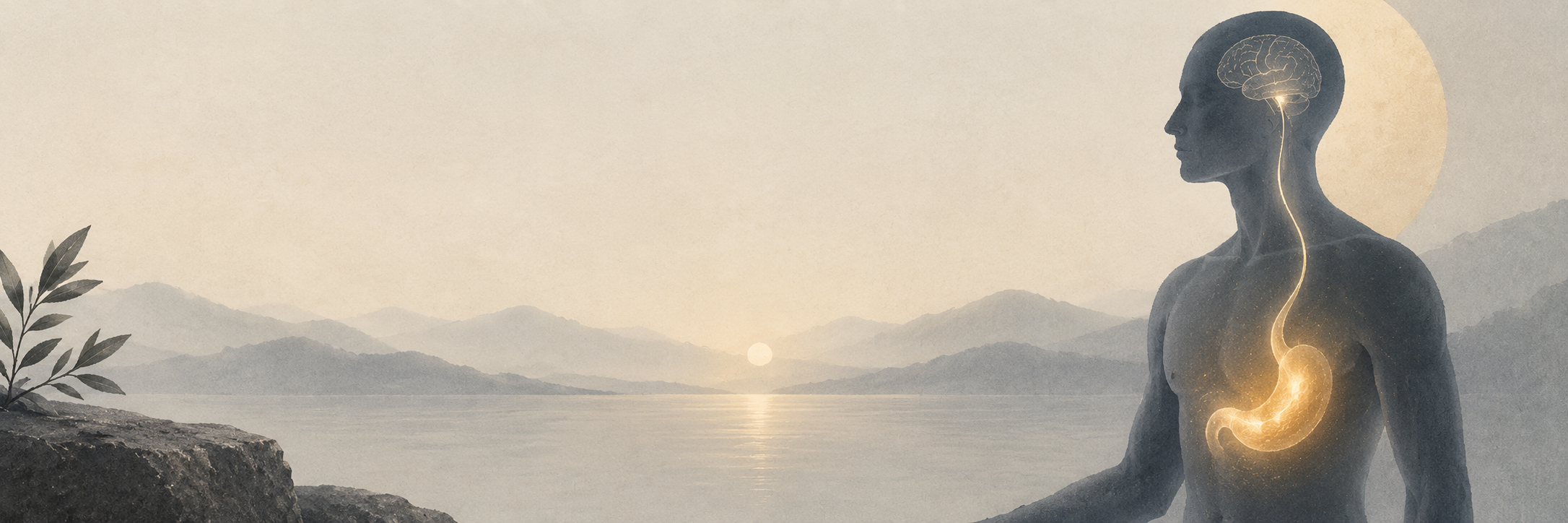
The notion of the gut-brain axis has seen a recent virality in academic circles. A quick glance at PubMed shows a steady increase starting over the last decade or so, with an exponential increase in the last couple of years. An aspect that is a little bit funny to me as I was looking into this topic is the notion of a "rediscovery" of the gut-brain axis. I believe the modern era of academic science has a bias that makes its outputs inseparable from the ego, with what I would call a fixation on perspectives that are safe and comfortable to the rationalizing mind. This is why it seems intuitive that the Enteric Nervous System can operate autonomously, and why it is easily accepted that the brain can influence the function of the gastrointestinal system through the enteric system. But that the gut may actually influence the mind? This is something which has only "recently" become clinically validated, leading to a wave of "new age" treatments. [3]
The conventional description of the enteric system is dominated by the mechanistic function of digestion. The act of consumption and excretion are highly observable functions and easily lectured and testable as a grand waterfall of biochemical and electrical reactions. In this view, the core use of the enteric system is to allow for autonomous digestion, so we do not need to think about our digestion for it to occur.
Instead, through local neuronal networks like stretch and distention receptors, intestinal motility can occur simply with the presence of a bolus through release of neurotransmitters.
When a bolus stretches the gut wall, the local circuit coordinates contraction behind it with relaxation ahead of it, using acetylcholine and substance P for contraction and nitric oxide and vasoactive intestinal peptide for relaxation. [1][2]
Further along in the stomach, the bolus becomes chyme as acids and digestive fluids break down this biomass, while chemoreceptors identify molecular fragments which trigger secretory cell behavior, allowing hormones and enzymes to further engage in this digestive process, severing peptide bonds or regulating gastric levels.
The brain can affect this process as well, for instance through vagus nerve signaling, a parasympathetic pathway which can be used to to reinforce motility, or in coordinating the sympathetic pathways to shut down digestion in times of stress. [1][2]
But when I first began reading about the "new" directional interaction, the gut's influence on the brain, which forms the basis of this concept of the gut-brain axis (or more likely, the power of the gut over mental states, stress levels and whole body inflammatory responses, among other systemic influences), what I was reminded of was ancient but "unscientific" notions of chakras and qi, which I decided to dig more into for this discussion.
With a quick search, I found reference to the centrality of the gut to the overall human biological system in texts which stem back to the 6th Century BCE, about 2600 years ago. In the Taittiryaka Upanishad [5], food is described as the foundation of human life, and to me it is clear that this is not a reference to agriculture or to the literal acts around eating. For instance we see the stanzas such as:
"(1-2) Bhu is Prana (up-breathing), Bhuvas is Apana (down-breathing), Suvas is Vyana (backbreathing). Mahas is food. All breathings are increased by food."
"Man thus consists of the essence of food. This is his head, this his right arm, this his left arm, this his trunk (Atman), this the seat (the support)."
"They who worship food as Brahman, obtain all food. For food is the oldest of all beings, and therefore it is called panacea."
"Breath is food', the body eats the food. The body rests on breath, breath rests on the body. This is the food resting on food."
To me, this represents an ancient understanding that the stomach and digestive organs form a foundational aspect of not just nutrient processing, but our humanity. It is not just a place where nutrients are processed chemically, but the seat of the experience of living. In this Upanishad the sanctity of food precedes the mind and even the soul. I believe my interpretation is validated further from practices and debates that stem in Ayurvedic medicinal traditions, where Agni, the core fire of man, the "base of life," is so intertwined with the concept of digestion, Pitta, that it seems to be a matter of debate in the Ayurvedic community whether they are two separate concepts at all. [6]
Could it be that there is only Agni, and that digestion and the root of life are inseparably one and the same?
In this tradition it seems, the base of human existence is not in the mind, or the nervous system, but in Agni, in food and digestion, to such an extent that "if the Agni of a person is vitiated, the whole metabolism in his body would be disturbed, resulting in ill health and disease." [6]
This aligns well with the veneration of "food" as the divine aspect of man and as medicine in the Upanishad I presented.
From the early twentieth-century Japan too, I found an interesting case of modern orthodoxy transmuting ancient knowledge in the practices of Dr. Futaki Kenzō, a pre-eminent Western-trained microbiologist at Tokyo Imperial University. In way of background, it is worth establishing that Dr. Futaki was a heavily credentialed post-Meiji reformation scientist, not an ascetic monk who practiced traditional medicine in the woods somewhere. He trained in Munich under Max von Gruber, served as acting director of Japan's National Institute of Infectious Diseases, helped identify the infectious agent behind rat-bite fever, and eventually received the Order of Culture from the Emperor for his contributions to international standing of the Japanese scientific community.
But before 1945 he was actually better known to the Japanese public for his breathing method than for his microbiology. [7]
In the paper by Yu-Chuan Wu, we relive the struggle Futaki experienced trying to merge the intuition of an ancient tradition with what I would call the modern fanaticism for empiricism regardless of the costs of its reductionism. Futaki's focus was to investigate and explain the therapeutic effects of breathing techniques on neurasthenia, which seems to be a term for generalized anxiety disorders that was commonly diagnosed in the era.
His own account began with two eighteenth-century books he said he encountered while growing up in a family of Han medicine practitioners, although Wu notes that parts of this origin story are difficult to verify. [7]
The mental gymnastics in Futaki's trials are evident though, for instance implicating the introduction of Western chairs and clothing in the symptom of weakened abdominal breathing, triggering the disorder, which core-strengthening breathing techniques could then remediate.
He attempted to translate this into a theory on circulation, claiming that abdominal pressure helped return venous blood to the heart and describing the abdomen as an “abdominal heart.” He even reported testing patients with an abdominal pressure meter, although he never explained the design of the device or published the data. [7]
I think this somewhat performative science, and the later shift toward psychological explanations of neurasthenia, likely helps explain why the physiological account faded from common medical therapy, even if the breathing practices themselves continued, more often kept alive in cultural and spiritual practices as opposed to medical clinics. And as an interesting aside, Wu also found the term “abdominal brain” being used in this time, well before this notion of the second brain as is being used today. [7]
And despite all of this, in the 2020s we now say that these types of breathing exercises are "new age" therapies, allowing them to reemerge in clinical environments without the stain of ancient esotericism perhaps. Current "frontiers" of cognitive therapies for instance, are rediscovering clinical therapies that seem indistinguishable from Dr. Futaki's concepts of breath work, which he himself claimed to be based on 18th century texts he was exposed growing up in a family of Han medicine practitioners, whose own ideas can date back to even older Daoist beliefs. It seems to me that these new therapies and their logic are restating ideas I've introduced on the importance of the gut that had already existed from very early on in the halls of human wisdom.
Clinicians are rediscovering essentially, the importance of prolonged habitual parasympathetic rest and digest activation, often using breath work to achieve, on the overall systemic well being of individuals. The modern clinical vocabulary is brain-gut behavioral therapy, which can include diaphragmatic breathing, cognitive behavioral therapy directed toward gastrointestinal symptoms, gut-directed mindfulness and even hypnotherapy. The New York GA seminar describes breathing as a way to interrupt a stress response which might otherwise remain active throughout the day, while the Cleveland Clinic seminar describes how anxiety, attention to symptoms and food avoidance can reinforce one another in patients whose gut sensations have become hypersensitive. [3][4]
These are more sophisticated explanations than Futaki's abdominal pressure meter, though the practical recommendation has traveled less distance than the terminology around it.
I also recall the brief period when the Wim Hof method was making mainstream news, and when scientists seemed to be wiring every Buddhist monk they could get their hands on to modern neuroimaging devices. The specific findings are easy to overstate as changes in “brain chemistry,” but Wu's narrower observation is enough for my point, that breathing and meditation are returning as psychotherapeutic methods whose effects could now be made visible, for instance, as changes in blood flow in relevant parts of the brain. [7]
Admittedly, it is easier for me to make these connections in hindsight, as the growing body of clinical evidence is building. And I am picking a little unfairly on the behavioral therapy field. Add the word inflammatory or microbiome to gut-brain axis and many other fields would be implicated just as equally. However, it seems clear to me, after looking into all this, how essential open mindedness is if people are to continue making scientific progress.
Sources
- Ninja Nerd — "Neurology | Enteric Nervous System"
- Dr Matt & Dr Mike — "Enteric Nervous System | Neural Regulation of the Digestive System"
- New York Gastroenterology Associates — "The Gut-Brain Connection: The Latest Research & Practical Approaches to Treatment"
- Cleveland Clinic Digestive Disease Institute, Nutrition Live — "The Gut-Brain Connection"
- Taittiriya Upanishad — translated by F. Max Müller
- Agrawal AK, Yadav CR, Meena MS — "Physiological aspects of Agni" (AYU, 2010)
- Wu Y-C — "A Disorder of Qi: Breathing Exercise as a Cure for Neurasthenia in Japan, 1900–1945" (Journal of the History of Medicine and Allied Sciences, 2016)